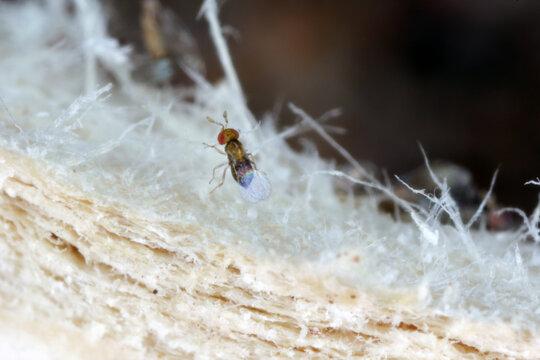
Tiny parasitic wasps in your closet sound like clickbait.
Over the last couple of years Trichogramma wasps have been promoted as a miracle fix for clothes moths, with sponsored Google results, glowing blog posts, YouTube shorts, Reddit anecdotes, a KQED science feature, and a New York Times Magazine piece all pointing in the same direction: "Hang a few cards, unleash thousands of microscopic wasps, and your sweaters are saved."
The reality is more complicated. Some Trichogramma species really can attack clothes moth eggs and are already used in museums and in a few consumer products. Others are optimized for crop pests and probably do very little in your wardrobe. Most coverage glosses over that distinction.
This article is meant to be the thing I wished existed before I went down that rabbit hole.
Quick refresher: how clothes moths actually behave
The main villain in most homes is the common or webbing clothes moth, Tineola bisselliella. Adults are the small buff‑colored moths you see fluttering lazily around a closet. The adults do not eat at all. All the damage is done by the larvae, which feed on keratin in wool, silk, feathers, fur and similar materials.
A very compressed life cycle:
- Eggs – tiny, about half a millimeter, glued to fibers in dark undisturbed areas.
- Larvae – creamy caterpillars that graze on fabric and sometimes live in silken tubes or cases.
- Pupae – cocoons tucked into seams, under carpets or inside furniture.
- Adults – live for roughly one to two weeks, mate, lay up to a few hundred eggs, then die.
Moth Life Cycle
Eggs
Tiny, ~0.5mm, glued to fibers
Larvae
Creamy caterpillars grazing on fabric
Pupae
Cocoons in seams and furniture
Adults
1-2 weeks, mate, lay eggs
Heated buildings let them breed all year, so an infestation can feel endless.
The weak point is the egg stage. If you can destroy eggs before they hatch, you break the cycle. That is exactly what Trichogramma wasps do.
What Trichogramma wasps are and how they work
Trichogramma are a whole genus of tiny egg parasitoid wasps. They are microscopic, often under 0.5 mm long, and they specialize in laying their eggs inside the eggs of moths and butterflies.
Mechanics, simplified:
- A female Trichogramma smells and feels her way to moth eggs.
- She drills through the eggshell and lays her own egg inside.
- The wasp larva eats the developing caterpillar inside the moth egg.
- A new wasp emerges from what would have been a moth.
How Trichogramma Works
The parasitization process
Moth Lays Eggs
Clothes moth lays eggs in dark fabric crevices
Wasp Locates Eggs
Wasp locates moth eggs using chemical cues
Egg Parasitization
Wasp injects an egg into each moth egg
Egg Darkens
Parasitized eggs turn dark and no moth will emerge
Wasp Emerges
New adult wasps repeat the process
They do not sting people or pets. When there are no suitable moth eggs left, the wasps die out within a few weeks.
Trichogramma are already mass‑produced worldwide for agriculture and stored‑product pests.
So in principle the idea is sound: if you can match the right Trichogramma species to clothes moth eggs, you get a living, self‑replicating insecticide that stops the next generation of fabric‑eating larvae.
The catch is that "match the right species" part.
The evidence: can Trichogramma really control clothes moths?
What real-world trials, consumer products, and species-level research actually show.
1. Museum and heritage trials
Where the clearest documentation exists — conservators record pest data meticulously.
Museum & heritage trial environments
National Trust (UK)
Multi-year trial using T. evanescens alongside pheromone traps in historic houses.
Outcome
Parasitism clearly occurred, but traps plus wasps did not outperform traps alone in very large, high-ceiling rooms. The Trust suggests wasps may still be useful in small stores or highly localized problem areas.
Burghley House (UK)
A three-month dissertation-based trial in a persistent moth infestation.
Outcome
Logistically feasible, likely helpful, but the author explicitly notes a full year of releases is needed for firm conclusions.
National Museums Scotland — Argyle Motorcar
Dense clothes moth colony inside horsehair upholstery of an early twentieth-century car.
Outcome
After deploying T. evanescens sachets, trap counts dropped and stayed low. The conservator considers the treatment a success for this very localized infestation.
Takeaway
2. Consumer products in Europe and the UK
Multiple companies now sell household Trichogramma products targeted at textile and pantry moths.
Hanging Card
Sachet Envelope
Room Coverage
Commercial product formats
Examples
Pest Free Gardening (UK) "T-gramma" cards for clothes and food moths containing ~2,000 wasps per card.
Dragonfli (UK) "Clothes Moth Egg Killer Sachets" releasing ~2,000 T. evanescens per week over 2–4 weeks.
German & Swiss suppliers Similar T. evanescens cards used for stored-product pests and some household moth species.
3. Australia: T. pretiosum for clothes and pantry moths
A different species, but a long-running, expert-backed program.
Australian distribution program
How the Australian program works
Why T. pretiosum?
Decades of use against crop caterpillars show it is robust, easy to rear, and capable of locating moth eggs in domestic settings.
4. What about T. brassicae and T. minutum?
Species differences matter — a lot.
Species differentiation & host specificity
Most Trichogramma cards sold in the US are agricultural formulations aimed at field and orchard pests, not textile pests.
Why this is a problem
What US entomologists say
Extension services repeatedly caution that:
- Household humidity and resources are not ideal for agricultural Trichogramma
- Repeated releases would be costlier than physical control steps
- Accessing eggs in food or clothing is often impractical
- Evidence for indoor use against clothes moths is not yet available
The US situation: lots of Trichogramma, not much tailored to clothes moths
If you are in the United States, the cards that show up first when you search "Trichogramma wasps for clothes moths" are typically agricultural formulations. A good example is the NaturesGoodGuys "Trichogramma Eggs on Hanging Cards" that you can buy on Amazon or directly.
On that product page, the dropdown that lets you choose "size" actually hides the critical information:
- 10,000, 50,000, or 100,000 T. brassicae (labeled for "cole/cold crops and ornamentals").
- 10,000, 50,000, or 100,000 T. platneri / T. minutum (labeled for "tall crops").
Further down, the same page explains that:
- T. brassicae is ideal for European corn borer and similar pests in vegetables and field crops.
- T. minutum and T. platneri are aimed at codling moth, gypsy moth, and other orchard pests on tall plants.
Despite that, the company blog has a post titled "How Trichogramma Protect Your Clothes from Moth Damage" that suggests hanging these cards in closets and pantries.
Another major supplier, Arbico Organics, sells T. brassicae, T. minutum, T. platneri and T. pretiosum as "moth egg parasites" and talks broadly about their use in agriculture and home gardens. The category description even notes that "moth egg parasites are readily used indoors in the United Kingdom for controlling common clothes moths," which is almost certainly a reference to the T. evanescens programs, but Arbico does not offer T. evanescens itself.
You can see how an ordinary homeowner might conclude that any Trichogramma card is the same thing the museums and European companies are using. That is not the case.
What do US entomologists say?
Extension services and independent experts are cautious.
- A University of Maryland Extension response to a homeowner, who had read about Trichogramma in the New York Times and wanted to treat clothes moths indoors, said they did not think parasitoid wasps would be "practical or cost‑effective" in homes. They pointed out that most biocontrol species need specific humidity and food resources, and that repeated releases would probably cost more than traditional control measures like cleaning, sealing and storage.
- In a Q&A on the Planet Natural forums, when asked whether their Trichogramma products were good for clothes moths, the company replied that they had no scientific backing to say it worked and could not recommend Trichogramma for that purpose.
- Another Ask Extension answer about pantry moths notes that Trichogramma would have to access the eggs inside your stored food to have any effect, which is usually not acceptable, and again recommends physical removal and airtight storage instead.
Taken together, the picture in North America looks like this:
- Agricultural Trichogramma species are widely sold.
- Some marketing material implies they can be used for clothes moths, but the underlying testing and species choice are about crop and orchard pests, not wardrobe infestations.
- Independent entomologists are not ready to endorse household use against clothes moths yet.
Species really matter
Here is a clean comparison grid summarizing the evidence:
| Species | Sold for home moth control? | Evidence for clothes moth eggs | Typical purpose |
|---|---|---|---|
| T. evanescens | UK & EU consumer cards | Museum trials; effective in localized infestations | Stored product + textile moths |
| T. pretiosum | Australian household program | Field anecdotes; domestic reduction reported | Major agricultural biocontrol species |
| T. brassicae | Widely sold in US for crops | Lab evidence only; no real-world trials | Vegetable + field crops |
| T. minutum / T. platneri | Sold to home gardeners | No evidence for clothes moths | Orchard + tall crop pests |
Where the hype and the coverage fall short
Media coverage
Pieces from KQED, ABC and the New York Times have done a good job explaining the basic biology and the appeal of non‑toxic control.
What they tend not to spell out:
- Species and geography. An article may interview a UK conservator using T. evanescens and then quote a US supplier whose product actually contains T. brassicae and T. minutum for crop pests. To a casual reader it all sounds like the same thing.
- Need for repeated releases. European and Australian suppliers quietly recommend multiple rounds, often monthly, because adults live only a couple of weeks and clothes moth life cycles are long.
- Role of basic housekeeping. The more serious practitioners stress that wasps are one part of a program that still includes vacuuming, freezing, heat treatments and sealed storage.
Online stores and SEO blogs
Vendor blogs and affiliate pages often mirror the same talking points. They usually get the basic mechanism right and emphasize that the wasps die out when the food source is gone, which is true.
Where they are weaker:
- They rarely state which moth species the product has actually been tested against.
- Agricultural cards are suggested for use "indoors" even when the label clearly says they are optimized for crops like corn or grapes.
- Quantitative performance is almost never discussed. You see sentences like "highly effective for many of our customers" instead of numbers.
Reddit and forums
Reddit threads on r/pestcontrol and elsewhere are mostly people asking whether they should try Trichogramma for stubborn clothes moth problems after trying traps and cleaning. The pattern is:
- A few people have tried European T. evanescens products and report fewer moths, but almost always alongside better storage and traps.
- Others used US agricultural cards and saw no obvious change.
- Many commenters, including some pest professionals, express skepticism and point out the species mismatch and lack of rigorous data.
They are useful as a sanity check that you are not the only one confused, but they are not a substitute for controlled studies.
So… should you use Trichogramma wasps for clothes moths?
Short practical answer:
- In Europe or Australia, maybe, if you buy the right species and treat them as one part of a broader plan.
- In the US, I would not rely on currently available agricultural cards as my main line of defense, because they are not tailored to clothes moths and experts are cautious about their value in homes.
Let us break that down.
Step zero everywhere: do the boring stuff first
Regardless of where you live, the core of clothes moth control is still physical and environmental:
- Thorough vacuuming, especially baseboards, under furniture, inside closets and along carpet edges. Dispose of bags outside.
- Launder or dry‑clean infested clothing. For delicate items, several days in a deep freezer also works.
- Store off‑season garments in airtight bags or containers after cleaning.
- Use pheromone traps specific to clothes moths to monitor and catch males. They will not solve the problem alone, but they tell you if you are winning.
Only when that foundation is in place should you think about wasps.
If you are in the UK or EU
If you want to try Trichogramma, look for products that explicitly state:
- Species: Trichogramma evanescens.
- Target: clothes moth or textile moth and, optionally, food moth.
How to use them, distilled from multiple suppliers and case studies:
- Treat clearly defined spaces, like one wardrobe or one room at a time. Each card or sachet usually covers about 25 m² or a single closet.
- Hang the card without opening it, away from direct sun and heaters. Wasps emerge through small slits.
- Keep temperatures at or above roughly 20 °C when possible. The wasps are sluggish in cooler rooms.
- Replace cards every two to three weeks for at least three cycles. That covers multiple waves of eggs.
Realistic expectation: you might see trap counts and visible damage decline faster than with traps and cleaning alone, especially in contained storage spaces. You are unlikely to see a one‑card miracle cure for an entire house.
If you are in Australia
The advice from Bugs for Bugs and the ABC story is very similar, just with T. pretiosum instead of T. evanescens.
Key points they stress:
- Use high enough densities: one cup (about 2,400 wasps) or several cards per square meter of storage.
- Start preventively or at the first sign of moths, and repeat monthly until there is no activity.
- Combine with freezing suspect garments, careful inspection of op‑shop finds and general hygiene.
If you follow that playbook, you are at least using a product whose design and support explicitly target the moths you care about.
If you are in the US or Canada
Right now, almost everything easily available online is based on T. brassicae, T. minutum, or T. platneri.
Scientifically, T. brassicae can attack clothes moth eggs in lab settings, but:
- It is manufactured and sold primarily for field pests like European corn borer and codling moth.
- Independent reviews do not list it as a go‑to species for stored‑product or textile moth control.
- Extension entomologists and some vendors explicitly say they cannot recommend these general Trichogramma products for clothes moths in homes, due to lack of data and practical constraints.
If you still choose to experiment:
- Treat it as an experiment, not a guaranteed fix.
- Confine releases to a small area like one closet so you at least have a chance of the wasps encountering eggs.
- Document trap counts before and after, so you can decide whether the cost and hassle are worth it.
Personally, based on the current evidence, I would put my time and money into:
- Aggressive cleaning and storage.
- High quality pheromone traps in each at‑risk room.
- Possibly heat or freezing treatments for expensive rugs and furniture.
and only layer Trichogramma on top if and when a product similar to the European T. evanescens or Australian T. pretiosum lines becomes available domestically.
Bottom line
Trichogramma wasps are not snake oil. Specific species, used thoughtfully as part of an integrated program, clearly can help suppress clothes moth populations in certain contexts. Museums, European household products and Australian programs all support that picture for T. evanescens and T. pretiosum.
What the current wave of hype often hides is that:
- Species and formulation matter a lot.
- The best‑documented species for clothes moths are not the ones most US consumers are actually being sold.
- Even with the right species, you are signing up for repeated releases and careful housekeeping, not a single magic card you forget about.
If you write up your own experience with all of this, especially with clear before‑and‑after trap counts and which species you used, you will genuinely be contributing to the small but growing pool of real‑world data on this topic.
And you will definitely spare the next person from having seven tabs of pest‑control PDFs open just to decide between T. brassicae and "that other T‑word."
References
I wanted these to work because the idea is elegant and non-toxic. But the research and my own tests both pointed to the same answer: they're designed for different moths in different environments.
What I'd do instead
- Use heat treatment or freezing for clothes moths instead of biocontrol products
- Save biocontrol budgets for proven methods like good pheromone traps and sealed storage
- If you're curious about biocontrol, read museum IPM guides to see why they don't use it either
- Focus on environmental controls that make your space inhospitable to moths year-round
If you're deciding what to try next
— Notes from testing this in a small NYC apartment